Showing posts with label France. Show all posts

Strasbourg's Notre Dame and MORE!


The huge cathedral casts its shadow over the whole city.
In front of the cathedral, street musicians play The Theme From The Godfather

Strasbourg, the capital of Alsace, is only about an hour and a half away.  Well, unless you have no GPS, and no map.  Then you pick and feel your way along the byways, or pull out your sextant…whoops, only works at night.  Sun shots are tough and even tougher when you’re driving on what in the U.S. would be a practice stretch at the Daytona Speedway.

Germany into France is seamless these days.  The signage changes, the speed drops from blazing to scorching.  Houses in the small towns seem a little more down at the mouth.  Rolling green, wooded hills and miles of open green pasture, strewn with languid cows and sheep don’t change.

I got to the center of Strasbourg in under two hours, which immediately called for cold beer at an outdoor café.   I like an Alsatian brew, Fischer. Fortunately, there are cafés aplenty, sprawling out in the plaza in front of the famous cathedral. 


Quench your thirst and hustle over to the Tourist Information Center, in the same square as the cathedral.

First question:  What do you like to do when you get to a new city?  Take a tour?  Pick out the best of the best from a guidebook?  Pull out the mandatory list acquaintances you don’t even like forced on you? 

Cast off that shadow of shame and doubt.  Be bold.


Gugelhupf - something like a Bundt Cake, in every bakery window.


I say, screw ‘em.  I like to pick out a spot or two that appeals to me.  If you said bars and outdoor cafés you’d be on the right track.  But, also I have to give the deity his/her/its due. Sentences get so complicated when you do your best to appease everyone’s point of view.  I should have added non-deity somewhere, but I do have my limits.


Back to Strasbourg and it’s cathedral.   Can’t miss it.  Center of the city.  A single tower makes it look a little cockeyed, because they never got around to building the twin. Cathedral of Our Lady of Strasbourg is the proper name, but its also called Strasbourg Minster.

Parts of the cathedral were begun in the early 13thCentury, but it wasn’t complete and open until a hundred years later.  Very impressive Gothic construction, over 460 feet high, with huge flying buttresses and lace-like stonework.  One of the many points of interest is inside, at the Astronomical Clock, where the twelve apostles parade before Christ every day at 1230.  Get there early.  The faithful and the gawkers press in like poor relatives at the reading of the will.


“Built” and “complete” are interesting terms.  Places of worship have occupied the site of this cathedral since Roman times, including several previous Christian churches.  Used to be the tallest cathedral in Europe until the Lutherans in Hamburg outdid themselves in the middle of the 19th Century and built St. Nicolas Church.  Still Strasbourg’s Cathedral of Our Lady is still the 6th tallest church in the world. And you’re still walking where Roman sandals scuffed the stones.

Want a thirsty experience?  Climb the 330 stone stairs…steep, narrow stairs…to the top.  Worth the gasping trip for a beautiful panorama of the entire city.  While you stroll above the rooftops, note all the graffiti from the Middle Ages.  Etchings crowd around the arched doorways.  Along the way, you’ll get a fantastic view of the flying buttresses.


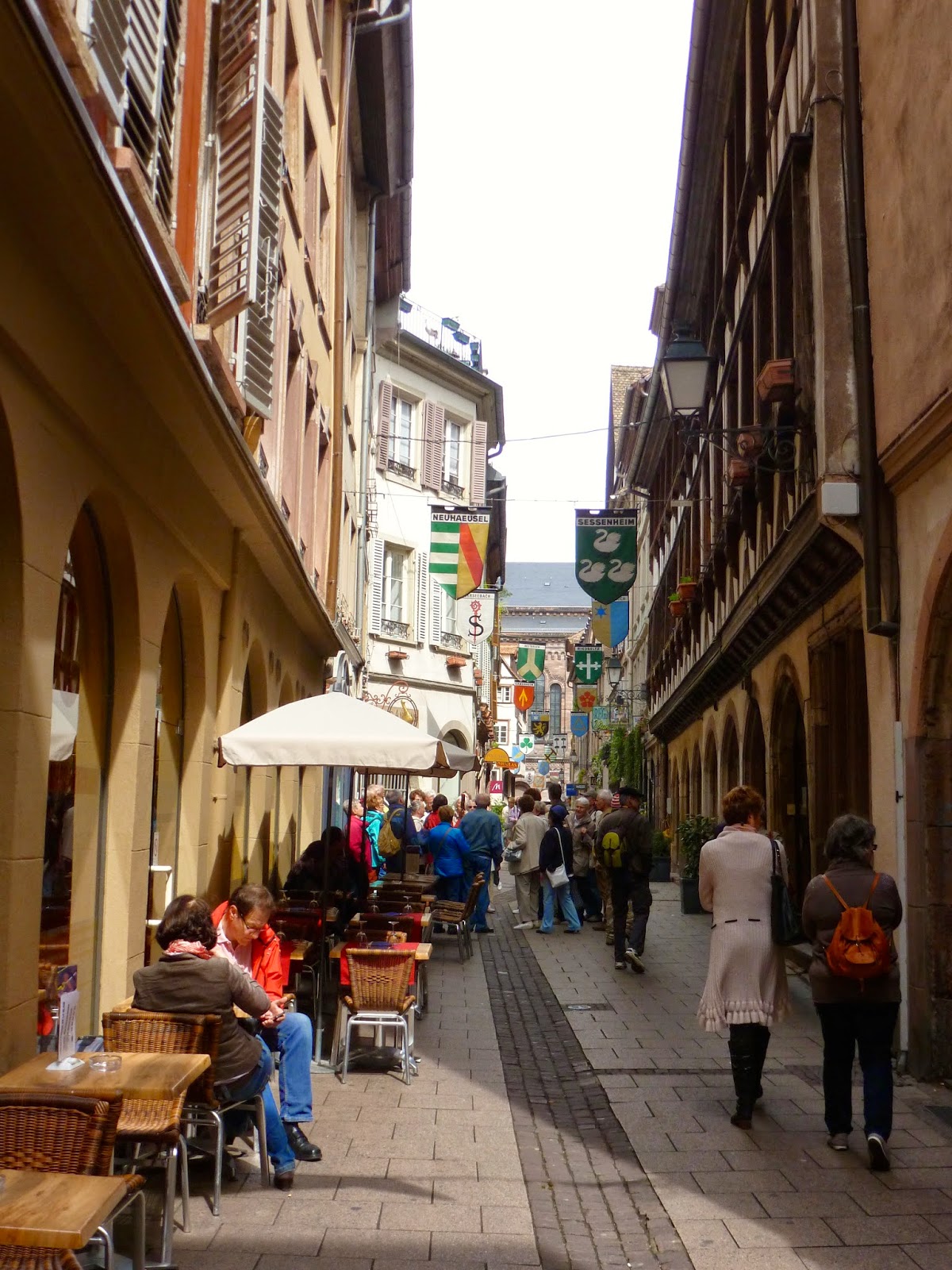
Yes, there’s more to Strasbourg than a cathedral. There are museums and architectural wonders to keep you entertained, but I went to the heart of the old quarter, called Le Petite France.  Lots of half-timbered buildings.  Right on the canal and a perfect spot to find an outdoor café, bite into some lunch and sample some of the justly famous Alsatian wines or beers.


Most of the buildings in the old quarter belonged to tanners, who made use of the canal.  The buildings date mostly from the 16th and 17th Centuries.

Passing out of the narrow lanes of Le Petite France, you won’t want to miss the long covered bridge and the old city towers.  Near the towers, right on the canal is one of my favorite Strasbourg restaurants, L’Ami Schutz. Beautiful interior, yet cozy.  Alsatian specialties galore.

The Covered Bridge, designed by the famous military engineer, Vauban, around 1681, gates within could be opened and the southern part of the city flooded for defense.


Stroll the streets some more. Check out La Place Gutenberg, with a statue of the man himself and one of the most beautiful Renaissance buildings in the city, the former city-hall, built in 1585.  By the way, although he was born in Germany, Gutenberg lived in Strasbourg for ten years or more, developing his printing press.

La Place Gutenberg

Time to wander again, but not too far.  Pick out a bakery.  Eat some macaroons.  Grab a cup of coffee.  Feel more like a beer?  Ok.  No quarreling with that.


With the Cathedral tolling near six post meridian (meridiem in Latin), it’s time to find my car, pay the toll and figure out that taking the highway North means heading toward Paris, even though Paris is west of here.  No GPS, no map?  No problem.

Ribeauville: Another Jewel of the Alsace


Coming out of Rodern and still craving adventure, we trolled the country-side.  Still too early in the spring to put the top down on the Bimmer, but still fun on the narrow, winding roads that twist through the vineyards.  Vineyards.  With that simple word, most would picture a plot of land, maybe even a large plot.  But this is the Alsace.  Everything that’s not a road or a village is a vineyard.  Neat and cultivated rows of vines stretch like thin black ribbons, as far as you can see, across the flatland, and smoothly rolling with the low hills, until finally caressing the slopes of the mountains.

A road sign with an arrow reads:  Ribeauville.  Never been there.  Not yet. 

We leave the vineyards and roll into a town right out of the middle-ages.  For the avid sightseer, nothing beats the Alsace. All you need are some jingle in your pocket, and a sporty car.  Throw predetermined destination aside.  Just drive.  Be prepared to tap the brakes and park at the slightest provocation.

Keep a notebook and pen at hand, along with at least a pocket camera.  You’ll want to jot down the names of towns, the names of wines, general impressions.  Without a bit of a hint, memories melt.  The Alsace is a Disney-set on the grandest of scales.  Small villages.  Towns.  Cities.  All of them pop up with astonishing regularity. Each a jewel worthy of movie-star sunglasses, a casually swung scarf, and café-au-lait at a sidewalk café. Linger as if you belong and the tourists that pass are oh so passé.


In one small town, of which I will write more on another day, we stumbled into a remarkable chocolate shop.  Found out later, it was named one of the five best in France.  That’s the way life is when you allow yourself the time to meander aimlessly.  Expect the unexpected, such as:

A stork guards its nest, high on a steeple

Down below, an Aston Martin


Ribeauville was like that chocolate shop on a grander scale.  Half-timbered buildings.  Cobblestone streets.  Cafés whose tables and patrons spill out onto the old walking street.

The town, which is located 10 miles (16 km) north of Colmar and 47 miles (75 km) south of Strasbourg, kneels at the feet of the Vosges Mountains.  Heard of the Vosges?  More than a name, it’s the birthplace of the famous Rhine River. Across the border is the equally famous Black Forest.

Ribeauville’s history fades back to the 8thCentury.  Here’s an interesting tidbit:  the local king/prince/BMOC was the protector of wandering minstrels.  They paid protection money, of course.  That went on until the late 17th Century, when the noble family died out.  So these day, street musicians are on their own, but seem unconcerned by the change.  We heard a middle-aged woman, standing in front of a candy shop (confiserie), croon a wonderful version of La Vie En Rose.  Tune into youtube while you browse the Ribeauville photos (below). The song will make your eyes and heart well up.


Lots to do in the ville.  Old churches: St Gregory and St Augustine.  Castles: St Ulrich, Girsburg, and Haut Ribeaupierre.  As with most castles, these dominate the heights overlooking the city and through the centuries were built, destroyed, and rebuilt.

Or, you can do what we did and simply wander the remarkable streets.  Find a bread shop (boulangerie), pastry shop (patisserie), or just a friendly café.  Sit.  Watch the world go by and marvel at your good fortune.


In Search of Pinot Noir - A trip to Rodern


It’s Saturday.  A beautiful day blooms and my wife has an idea.  Ever the faithful servant, I pull out pen and paper and sit staring, much like a dog that can already smell the dog biscuit.

“I would like to drive to France,” she announces…or is that pronounces.  I no longer distinguish.

My mind rummages through a wastebasket of thoughts.  Seems to me… Of course, wine!  We need more wine!

“Rodern?” I offer.  The offer has a question mark because reading of minds is much to me like handling snakes.  But, Rodern is known as the ‘Cradle of Pinot Noir,’ so I can’t be too far off.

“Perfect!” she says.

We grab maps.  We google.  We load the GPS and fill the tank with gas. Planning at its most perfect.  Euros in the pocket?  Check.  Off on a cozy drive of three and a half hours through beautiful Alsace.

Rodern is an old, tidy village, one among many in the Alsace.  But, there’s a difference and that difference is the grape.  We’ve been there a few times.  Never tire of the place and a visit to our favorite vintner, Metz-Bleger.

You get off the highway and onto dusty, two lane roads.  Follow the signs into what appears to be a trip into the country. The village camps among expansive, rolling vineyards, overlooked by a sizeable castle.


Nestled in the heart of the village, appropriately located on Rue Pinot Noir, Metz-Bleger calls a very old building home.  Built in 1560, destroyed by fire and reconstructed in 2001, it looks new, outside and in, but proudly wears the marks of centuries, including a carriage-door frame whose stone is chiseled with 1541, and symbols of laborers and wine growers.  It’s not alone in its age.  The town is strewn with half-timbered houses, tile roofs, cobblestones, arched carriage doors, rimmed in carved stone and still bearing the symbols of coopers, vintners, and others.  These hark back to the days when not everyone was literate, much like parts of modern day America.

Metz-Bleger

The other side of Metz-Bleger


We stride into Metz-Bleger, just as a French family of four or five strolls out, cases in hand.  Sometimes the tasting room is open and sometimes one must ring the bell and wait for a stout, elderly woman, or her son to appear in the balcony and shout down at you.  Should it be a surprise we want wine and plenty of it???


She pours generously.  Our first trip here, we had a Designated Driver and could swill with abandon.  This time there’s just the two of us.  Even so, we try several Pinots and select a 2012 Réserve Particulière and a 2011 Vieillien Fut de Chene.  The first is a bright cherry red, but lacks nothing in flavor.  The second is a more typical Pinot, with deep color and a more redolent nose. Both sit smoothly on the palate. My French runs out.  The proprietress switches to German.  Good enough.

The history of Alsace is a history of warfare, especially in modern times.  War of 1870.  The Germans claimed it. Then came World War I and the French got it back.  Then came the Sieg Heilers and once again it was German until 1945.  A few years later, the people voted to become French.

Now the towns have either French or German names. History scattered from town to town. Older folks speak both languages, the youngsters only French.

Back to wine.  I confess, I had no idea about Pinot until I saw Sideways, the superb 2004 movie starring Paul Giamatti, Thomas Haden Church, and Virginia Maden, along with a most delectable Sandra Oh.  But, unlike the characters in the film, far be it from me bear the title of wine snob.  I know little and explore much.  The Bleger Pinots are superb to this unrefined worshiper.  I filled a car trunk the first time I came and have done some heavy lifting several times since.  Bought 48 bottles this time, along with a few bottles of Crémont, that excellent Alsace version of Champagne.


With a map/brochure to guide us, we wander the streets and alleys. A pity there’s no flesh and blood guide.  I suspect we barely clear the cobwebs off the history of this time capsule.


Yes, I could thrill you with details, but it’s more fun to go yourself.  Meanwhile, I’ll entertain you with photos of some of the town’s treasures.  You can walk the town rapidly, or take your time.  I suggest the latter.   You may have tasted more wine than you meant to.  Easy to do, especially when you know you’ve pleased your wife and can finally relax.

Wonderful wine at five to ten bucks a bottle, in a tiny, yet wonderful little treasure of a town in the Alsace.

House built in 1562

Here's the proof!
Church of St George.  Parts of it date to 1310.


The sign of a cooper, or barrel maker at 43 Rue de Pinot Noir

Down this road is the Schloessel, 1616

I could take photos of every shutter in the town!

How long did it take to wear down these steps?


A wine grower's house...big surprise!


Related Posts Plugin for WordPress, Blogger...