Showing posts with label southern cooking. Show all posts

Shrimp and Grits - My Way!


Shrimp and grits, my way.  Talk about a Southern low-country culinary tradition!  But, let me explain a few things to un-boggle your so-called mind.  Lots of people who have shivered through snow clogged winters, lived through dust storms on the great plains, and think their football teams can keep up with the teams from the southeast, have no idea what grits are.

First, some basic American history and meaningless trivia.  Native American tribes gifted the early English settlers with corn, or at least that’s how the story goes.

Stick with me….the word grits comes from the old English word, grytt, meaning coarse meal.

Now we get to the difference between cornmeal and grits, and you can stick polenta in there as well.  Grits are corn kernels that have had the husk and germ removed, usually using lye or another alkaline agent, which turns the kernels into hominy.  Looks like a nude kernel of corn that has never seen the sun.  As a matter of fact, grits are sometimes called hominy-grits. 

Now grind the hominy kernels.  In the old days, they used a stone mill for the grinding and you can still find ‘stone ground grits’ today.  Voilá!  You got yerself some grits.  Started out as mostly a breakfast food and I still love ‘em with eggs and sausage.

Flash forward to around 1985 when a New Yawk Times food writer, Craig Claiborne proclaimed the marvel of the sensational shrimp and grits he found at a North Carolina restaurant.  He wrote an article, and being from the Mississippi Delta himself, Mr. Claiborne knew what he was talking about.

A note about Craig Claiborne, who passed away in 2000.  If you want to know about the basics of cooking, don’t go to Julia Child. Pick up any one of Mr. Claiborne’s books. 

http://topics.nytimes.com/top/reference/timestopics/people/c/craig_claiborne/index.html

Claiborne’s article turned into a twelve cylinder, culinary engine that powered grits from the backwoods into the spotlight.  Today, you’ll find shrimp and grits everywhere  from north to south and east to west, from hole-in-the-wall eateries, to the big name restaurants.  Along the way, every major chef in the country has added his two grits worth to the basic recipe.  Barbecue.  Red pepper.  Garlic.  Cheese.  Haven’t seen escargot and grits, but I know it’s coming.

Now, I’m not a purist, but I do like my shrimp and grits to taste like shrimp and grits.  If I wanted to taste barbecue, I’d go to Texas.

So let’s quit messin’ around and git to it!  My recipe is in two parts, as you might guess.  First the grits, then the shrimp.

First the Grits


1 Cup of grits (use the 5 minute variety if that’s all you can scrape up)
2 Cups of milk
2 Cups of water
salt to taste
coarse ground black pepper to taste
1 Stick of butter (using a half stick at a time)

  Note:  Your amounts may vary, depending on the grits you use, but in any case, stick with half water and half milk.

Put the first four ingredients and a half stick of butter in a sauce pan and bring to a boil.  Stir well. The recipe on your box of grits is going to ignore any mention of milk and is going to tell you to bring the water to a boil first, then add the grits.  BUT, I like my grits creamy, especially if I’m going to layer them with shrimp.  The secret to creamy grits is to bring everything to a boil at the same time.  Then, cover and lower the heat to a simmer.  Stir once in awhile until the grits are done.  Your box of grits will give you a pretty good guess at how long that will take.  If the grits become too thick, add a bit more water or milk and when they’re done, stir in the other half stick of butter.

Now the Shrimp


1 lb of large shrimp  (41 to 50 count per pound)
1 ½ Cups of chopped onions (medium chop on all the vegetables)
1 Cup chopped celery
½ Cup chopped bacon
½ Chopped red bell pepper
2 Tablespoons butter for cooking the vegetables
1 to 1 ½ Cups chicken broth
Splash of Worcestershire Sauce
Two pinches red pepper flakes (too much will overpower the flavor of the shrimp)
Salt to taste

¼ Cup butter + ¼ Cup flour, mixed into a paste

Low-medium heat.  Put the vegetables, the bacon, and 2 Tablespoons of butter in a sauté pan.  Cook until the vegetables are soft, but not brown.  Add the spices and shrimp. Stir.  As the shrimp turn pink, add a cup of the broth.  Stir in the flour-butter mixture and allow the mixture to thicken.  Continue to cook on a low temperature for another three minutes.  Add the remainder of the broth as needed to keep the sauce from getting too thick.  You’re looking for a creamy consistency.

Put a helping of grits in individual shallow bowls and ladle the sauced shrimp on top.  Super for breakfast, lunch, or dinner. 


Enjoy it with your breakfast coffee and juice, or with a light, white wine.


Cornbread Dressing - Simply Delicious

Everything you'll need

Holidays are times for favorites and that especially means food.   Gingerbread cookies, whose deliciousness floats through the house; Roasting turkey, cranberry sauce.  The list grows longer.  One of my special favorites, besides seeing my favorite elf, cozy by the fireside, with a naughty grin on her face…ah, lost my train of thought….oh, yeah, food.  Cornbread dressing!

Some call it stuffing, but I never stuff a turkey, so I call it dressing.  Dates back to my childhood, over half a century ago.  I picture my mother, who miraculously never weighted more than 105 pounds, in the uncomfortably warm kitchen, Vogue perfect, a starched apron completing the ensemble.  The oven going.  The stovetop, with half a dozen steaming pans, and on the counter a cast iron skillet loaded with day-old cornbread.  Why day-old instead of freshly baked?  Moisture, my lad.  Cornbread that’s a tad on the dry side soaks up the goodness of all that’s to follow.

It all starts with cornbread. Here’s my recipe, but feel free to use another.  The important things are to make it a day ahead and to make enough!  This is a single recipe that I use to make dressing that feeds 6-8.

2 Cups cornmeal (I use organic, non-genetically modified.  Just make sure it is a normal grind, not finely ground)
1/4 Cup sugar
2 teaspoons baking powder (non-aluminum)
1/2 teaspoon salt
1 Cup milk
1/4 Cup vegetable oil
2 egg whites, or 1 whole egg, beaten

Heat oven to 400ºF (200ºC).  Heavily grease an iron skillet or 8x9 inch pan.  Put the pan in the oven to heat while you mix the cornbread.

Combine the dry ingredients. Stir in the wet ingredients, mixing only until the dry ingredients are moist.  Do not over-mix.

Remove the pan from the oven, pour in the batter, and put the pan back in the pre-heated oven.  Bake for 20-25 minutes, or until a knife inserted in the middle comes out clean.

Once you have the cornbread, the rest is a cinch.

Prepare the vegetables:


1 1/2 Cups sliced celery
1 1/2 Cups roughly chopped onions
1 Carrot, shredded
1 1/2 sticks butter
2 Cans or 1 32 oz carton organic chicken broth

Melt the butter in a skillet, add the vegetables and stir.  Cook only until the vegetables are just soft.

While the vegetables are cooking, in a saucepan, heat the chicken broth and reduce by half.

Crumble the cornbread into a large bowl.  Add the cooked vegetables and mix lightly, being careful not to pack down the mixture.  Moisten with the reduced chicken broth and toss.  Do not let the mixture get soggy. Taste and add more broth or melted butter if you wish.

Put the dressing mixture in an ovenproof dish and bake at 350ºF (180ºC) until the tops of the chunks of dressing begin to brown.

Notice, the dressing is not packed down!


Already have the Turkey carved, the table set? Remove the dressing from the oven and serve with your favorite homemade turkey gravy.

Now that you’ve done your duty, crack open that bottle of bubbly and join your elf by the fireside.  Maybe the guests won’t notice.


Heirloom BBQ - in Hotlanta!

The outside ain't nothin' special, but inside....oh, man!
When you talk about barbeque, you’re talking about old jeans, standing outside, and moving around to keep the smoke outta your face. Anything else is only make believe barbeque for folks who would rather be at Starbucks and think mayo is spicy.

The word itself is strange.  Some end it with que and some with cue.  Some just write it as BBQ or Q.  The word has a dimly lit past, but probably comes from an Indian word meaning 'no sex until the meat is cooked.'  Hence the need for slow cooking. I made that up.  It really means sacred pit of fire.  Which I suppose could also apply to sex.

You’ll find the good stuff all over the southeast United States, from the lapping waters of the Atlanta on the east coast and west through the blazing sun of TexasBut, the type of barbeque changes. A few geographic hints tell you what to expect.  The further west you go, the more likely you’ll be eatin’ beef and red sauce.  Come east from Texas and you get more and more pork. North Carolina and north, you’ll have pork with vinegar-based sauce.  Cross the line into South Carolina and Georgia, and it’s pork, with a mustard based sauce.

In this day of cultural homogenization, you’ll likely find bits and pieces of each, but it’s rare to find a Q-Joint that does all of it well.

I found one, at 2243 Akers Mill Rd. Atlanta, GA.  It’s just off Hwy 285 and no matter where you are, make the trip!  Heirloom Bar B Que.  This is old-fashioned style Q, which only comes from hours and hours of smoking slabs of meat over a wood fire, with nothing hurried.  When you're doing barbeque, there's no substitute for low temps and lots of time.

At Heirloom, you’ll get smoky Q at it’s very best, whether you’re talkin’ fall-apart beef brisket, or pulled pork.  Have a particular style sauce you like?  They’ve got it.  Best of all, everything’s made in-house. 


Have you noticed a trend in the kinds of food I like?  First off, it’s fresh with a CAPITAL F!  Secondly, the chef (or in this case Chefs) have got to be passionate about what they do and how they do it.

Chef Jiyeon Lee is a South Korean native.  Taylor Cody is a Texan, transplanted.  Both labored through their apprenticeships at a list of places that would grab any knowledgeable foodie’s attention. You can read all about both chefs on the Heirloom web page.


What makes a great Q joint?  First off, it’s got to be so understated and unpretentious that the food is the only reason, outside of a flat tire, or medical emergency you’d give the place a second thought.  If it’s a chain, forget it. Packaged sauces? Climb back in your car.  But, if you don’t see a barbeque pit and smell the smoke, RUN.

In Heirloom’s case, you pull into a partially overgrown parking lot, and soon figure out you don’t have to go through an old convenience store to get to the food.  It’s next door. Walk in, belly up, and before the screen door flaps closed behind you, a smiling face will take your order.  While you wait on your grub, grab a white, plastic spoon and taste some of the sauces in a rack on the wall behind you. Take your time.  They’re all wonderful.


Heirloom is tiny, with an eclectic interior, and sensationally efficient service.  Grab your paper-wrapped bag of goodies, follow the crowd outside, and stand at an elbow-high table to savor the smoky flavors of a barbeque paradise. The sacred fire pit is right next to you.

I had the brisket and thought I’d been transported to Texas.  Brisket has got to be tender.  These savory slices fell apart.  Another in our party ate succulent pulled pork and said not one word until every scrap of the sandwich disappeared. Our fairest member dug into a half rack of fall-off-the-bone pork ribs.  She didn’t offer to share.

Specials and sides change by the day or the week, or whenever.  I had Korean style sweet potatoes, thinly sliced, fried, doused with a sweet soy sauce, and sprinkled with white sesame seeds.  A perfect accompaniment to the spicy, smoky tang of the brisket.


How do I find these places?  I often wonder that myself.  We’d driven four hours, and passed through on our way to somewhere else.  Just happened to read Heirloom had been named the Best Barbeque in Atlanta.  Never heard of the place. Culinary luck on a grand scale.

Now Heirloom's barbeque fills my dreams and as Ah-nuld says, Ah’ll be bock!


Commerce Kitchen Huntsville Alabama


Commerce Kitchen in Huntsville, Alabama offers superb food, in a bistro setting.  That’s really all I need to say, but then what the hell, maybe I’m being a little hard on myself.  The first question, followed by a bunch more:  Why would you want to eat there?  Why would you want to drive eight hours to eat there? What kind of food?  What’s the atmosphere?

I’m so sorry I opened this up to questions.

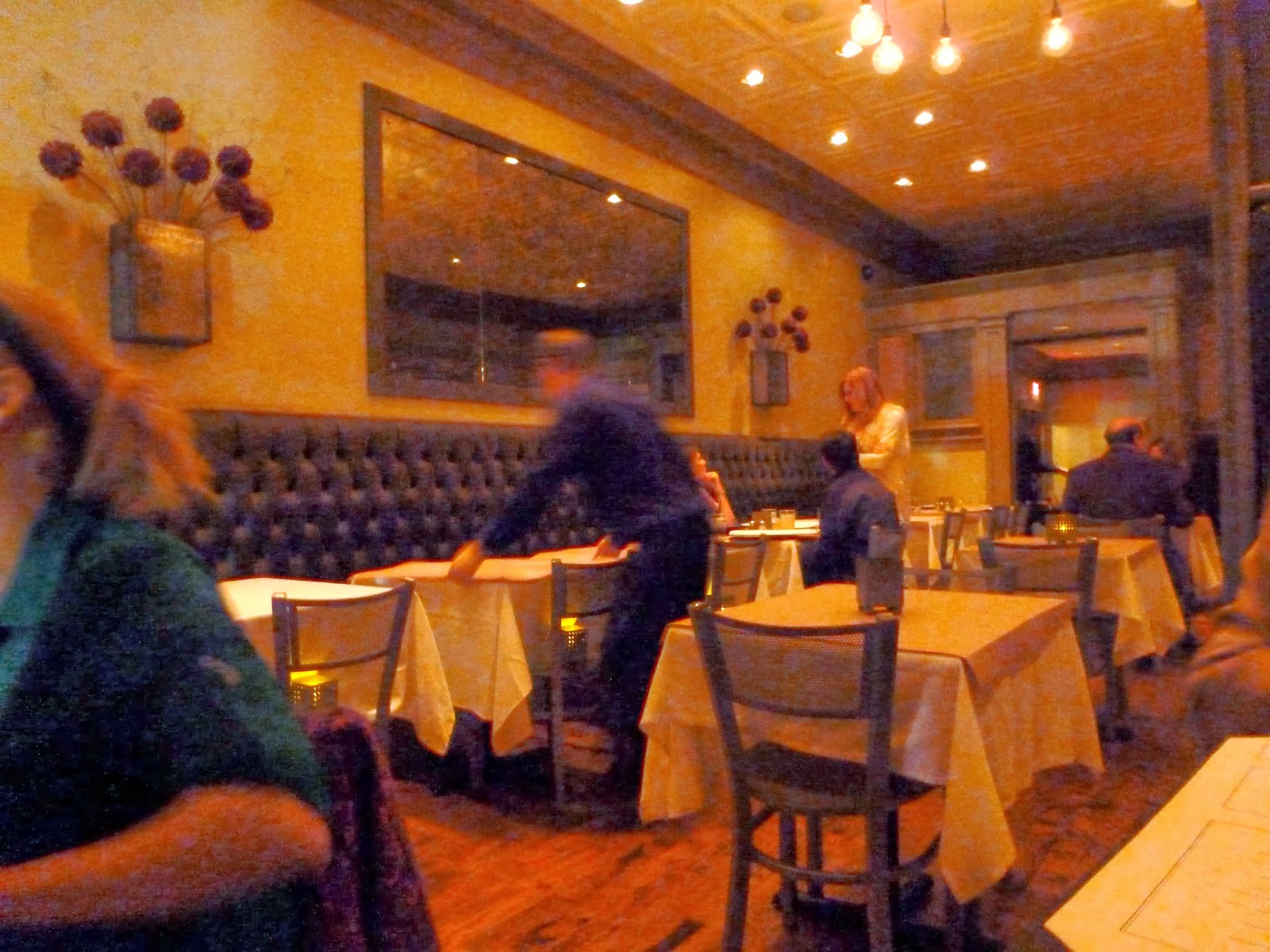
I’ll fling a name out.  Jimmy Boyce.  Learned the restaurant business across the county.  Le Cirque in New Yoak.  Years in L.A. and that doesn’t mean Lower Alabama.  Opened Cotton Row in Huntsville in 2008 and has a pizza joint in the Huntsville Art Museum.  High end.  Low end.  Commerce Kitchen, which Boyce owns with his wife and a business partner, fits in the middle.  He said he wanted the feel of a 1950’s steak house.  I think he missed the mark there, but that’s a good thing.  I strolled through the doors, into a dimly lit tangle of patrons clustered at an intimate bar.  Crowded, but not noisy.  This was a 1950s steak house all right, but one designed by a French bistro chef. 

Into the small, but inviting bar

Even the floors sport a casual elegance

Just the time and place for a bit of Jameson


Living in Europe, as I do, I immediately felt at home.  Comfortable.  Ready for a pre-meal libation and a chat with folks who might have something to say.  Europeans are like that.  They have not lost the art of conversation, nor the ritual of easing into a slow evening of dining.

To Europeans, dining is a sacred respite from the cares of the day.  Relaxing.  Catching up with friends and family.  It doesn’t end there.  What’s different about bistro fare in France, Italy, Spain, or Germany?  Freshness of ingredients.  Care in preparation.  Attention to detail, whether it’s the placement of silverware and glasses, or the lighting, and the way the attentive staff is not only well dressed, but knowledgeable.
It's the small touches

Commerce Kitchen fits solidly in the bistro world.  You want to ease in.  You want to linger.  Also this is Alabama, the heart of Dixie.  Life slows down. Commerce Kitchen is not only bistro in ambiance, but southern in charm.

Boyce wanted it that way.  He got it.  As author Steve Doyle quoted Boyce in AL.com, "It's not going to be duck liver and caviar. "It's going to be very familiar foods with our twist on it."

Here you find shrimp and grits, grilled salmon, rib-eye steak, and grits with short ribs.  But, always with a twist.  Our waiter knew all about it.  He’d worked in the kitchen and could describe the recipes to a T.


At 7:30 p.m. the crowds had yet to arrive


Nice touch, that.  I’m a fan of everyone in a business knowing all about that business.  I asked him about the glassware and it wasn’t a test.  I liked the glassware.  He knew the style and the company name.

“Ok,” you’re thinking, “enough of the small talk.  Give me a few hints about the food.”

Shrimp and Grillades

Gladly.  I started with the grits and short ribs, or Grillades as they’re called on the menu.  The name comes from New Orleans and means meat, usually beef, slow cooked with stock and vegetables until the meat falls into shreds, resting in a dark, indescribably delicious sauce.  The waiter recommended the dish and as soon as I bit in, I wanted to kiss him.  This was stewed meat over creamy grits taken to the level of angels.  The sauce was so rich I still dream about it.

What followed was a medium rare, blackened steak, with tender-crisp vegetables and a stack of crisp onion rings.  The steak was so tender no knife needed.  Yes, you can get steak practically anywhere.  No, you cannot get it cooked to perfection everywhere.  This was special.  A steak worthy of the name.

Tender, tender Rib-eye

The Kitchen's take on Pork and Beans - Pork Belly and Blackeyed Peas!

Smooth and creamy shrimp and grits


Dessert?  Are you kidding?  Of course!  You’re only fat once!  Absolutely decadent.  Chocolate Pecan Pie. A dollop of luscious whipped cream on top.  I’m still ashamed of myself.

How long were the five of us there?  Beats the hell outta me!  We talked of food and family and the pleasures of life.  Our waiter had a sixth sense about appearing when we needed him.

People often talk about a ‘feeding frenzy.’  You don’t go to Commerce Kitchen for that.  You go to slow your life down, chat with friends, and ease your way through an evening meal you will never forget. If you wannta try and beat Commerce Kitchen, buy yourself a ticket to France.  This was the best meal I’ve had in the U.S.A.


Americana à la Carte


When you enter an American city, even a small one, the tendrils of old time America trail off and disappear into the bulldozed, concreted urban mass.  I’m taking about the fruit and vegetable stands, the mom and pop groceries, the cheap diners with stained tablecloths, and the seafood shops whose hot grease aroma washes over you when you step out of your car.

Across the street from where my parents once lived, there used to be a good-sized stand with a hand painted sign advertising sweet melons.  Bushel baskets of brown skinned onions sat about.  Hand-sized wood cartons of bright red tomatoes, green peppers, green cased ears of corn, and yellow summer squash sat on long, trestle tables.  Down the street, a BBQ joint selling thick sandwiches of smoked pork welcomed you with wisps of fragrant smoke.  No longer.  They’ve been replaced by a branch bank and a big-chain supermarket.  You want some Americana, you have to venture farther a field.  Don’t even bother to look until you glance out the window at green pastures and rows of corn.  That’s when you find out it’s not just the vegetables and BBQ that’s missing.

I was outside Whitesboro, Texas, when I stopped at a vegetable stand.  Didn’t need vegetables.  “I’m lost,” I confessed to a man in jeans, a calico shirt, and a baseball cap.

“Fred,” he twanged at one of his customers, “Do you know where (whare) that road is?”  Fred didn’t know, but he suggested the guy running the bait shop next door might.  I started to walk that way, but Fred had already left.  “Jest a sec,” the owner told me.

About 30 seconds later, the man from the bait shop walked in.  Turned out he didn’t know either, but he led me back to his shop where he had some maps.  The maps did no good, so he called his friend who’s a fireman.  A little while later, I was on my way straight to my destination.  Folks with big, friendly hearts are never too busy to help.

I’m pleased to report I found similar hospitality in the sprawling outskirts of Atlanta.

Truett Cathy’s first Atlanta restaurant was called the Dwarf Grill, a humble beginning to what has become the second largest fast food chain, Chick-fil-a.  Now a nation-wide collection of 1500 plus restaurants, with over $3.2 billion in annual sales, something new has been added, a group of nostalgia-laced eateries called Truett’s Grill, featuring a 1950’s era décor, complete with old cars, gas pumps, naugyhide covered booths, a toy train that races above the diners, and one heck of a southern breakfast.  But, more than that, the waitresses greet you with a “Mornin’, Hon” and hustle to take your order.  Coffee appears as if by mental telepathy.  All of this reflects the humble beginning and humble heart of their employer, Truett Cathy.  Never met the man myself, but good or bad, everything starts at the top.  Talked to a couple who go to church with Truett and couldn’t stop talking about all he’s done for the community and especially for small business just starting out.

Best of all was the breakfast of fried chicken filet, two eggs over easy, grits, and biscuit.  But, I have to admit the meal tasted a little better knowing about the warmth of the man who made it possible.

On the rough edges of Orangeburg, South Carolina, I found Duke’s BBQ.  Found it on a Saturday, as I passed through. Normally, I'm not attracted to BBQ restaurants with a buffet.  Normally.  Dukes was different and even if the smoked pork lacked a bit and the green beans were cooked past their prime, it was still worth a stop, just to observe the folks inside.  If the rough edges of South Carolina still hold to the old ways, you’d never notice at Duke’s. People of every background flock to the place.  High school grads, still wearing their mortarboards came in with their families.  Workmen wore stained clothes while they gobbled their ‘cue.  In one corner, a family and friends in coats and ties and dresses sat and prayed before digging in.

I’m not one of those who hunger for the good old days.  I like some of the big chain stores and the convenience of Internet shopping.  Sill, it’s nice to know the simple, friendly heart of America still beats as strong as ever.

Downhome Vegetarian - Cornbread and Collards

Cornbread Fixin's

Collard Makin's

Simple, but Country Elegant

All together now....slurrrrp!


I confess I’m a rib suckin’, barbequin’, unrepentant carnivore.  But, I have nice friends, including a close friend who’d rather jump on a live grenade than eat any part of anything that walks, crawls, flies, or swims.  I’ve been tempted to test that. 
When you cook for vegetarians, you start to be very inventive. No throwing juicy, delicious steaks on the barbe, peeing in the bushes, and clanging the dinner gong.  You pay more attention to flavors and color combinations, but most of all, everything you fix has to taste good and be filling. No fear. It can be done.
            Of course, there’s also the dainty, little finger in the air, ‘style-is-everything’ type of vegetarian,.  I avoid them. You probably know and despise one of your very own.  Lightly steamed breast of radish, with vinegar infused skirt of cabbage.  Served on a bed of thin sliced, gluten free, soy based, rabbit pellets.  I’d rather eat root veggies, still ripe with bovine droppings.
            I say, if you’re gonna do the dirty with the greens, grab some corn licker, bust a few brain cells, and make some stomach fillin’,  mouth-warterin’ victuals your gran-pappy would be proud to slap on his tin plate and drool down his chin.
            You know I’m talking about cornbread and collards.  Cornbread is one of the oldest American dishes.  Native Americans ground corn in the long ago, and passed the recipes on to southern colonists, who added some leavening agents and brought cornbread to such a high stage of the culinary art that even slayers of beasts will relish a tasty hunk.  Matter of fact, cornbread has been labeled one of the cornerstones of southern cuisine.  I’d vote for that, as long as you mention biscuits, barbeque, and rice.  Hold on a sec.  Gonna need more than four corners.  What about the greens?  Which brings up the savory subject of collards.  Collard is the colloquial form of the long-forgotten name “colewort,” and it comes from the same family as broccoli and cabbage.  Not a bad green gene pool.  Collards give you vitamin C, along with antibacterial, antiviral, and even anti-cancer properties.  Matter of fact, if you rub collards…..’nother story.  These days you don’t have to cut the leaves at exactly the right time and chop ‘em yourself.  That’s what the frozen section of the supermarket is for.
            Lets get cookin’!  We’ll do the collards first and let them stew while we make the cornbread.

Collards My Vegetarian Friend’s Way  (Look!  No bacon up my sleeve!)


            1  package (1 lb) frozen, chopped collard greens
1   medium onion
3   cloves garlic
1   carrot
3   tablespoons chopped jalapeños
32  ounces vegetable broth, about 4 1/2 cups
1   tablespoon salt (or to taste)
2   tablespoons vegetable oil (I use sunflower oil)

Finely chop the onion, garlic and carrot.  I use a food processor.  Heat the oil on medium-high, in a 2-3 quart pot, and add the chopped ingredients (except the collards).  Let them sweat until the onions are translucent, then add the vegetable broth.  Bring to a boil and add the collards, salt and jalapeños.  Simmer for at least 30 minutes or more.  The longer the better. Taste and add salt as necessary.  I’ve been known to splash in a little bit of vinegar and another bunch of chopped jalapeños at this point.

While the collards simmer, let’s make the cornbread. 

Cornbread  - the simple kind


2 cups yellow corn meal
1/4 cup sugar (optional)
2 tablespoons baking powder
1/2 teaspoon salt
1 beaten egg
1 1/4 cups milk (I use skim)

Preheat the oven to 400ºF or 200ºC.  Add about 1/4 cup oil to a 8-9 inch cast iron skillet and put the skillet in the hot oven.

Mix all the dry ingredients in a bowl.  Add the milk and mix.  Add the beaten egg.  The batter should move slowly around in the bowl, but not be watery.  If your batter is too thick, add a little more milk. If it’s too thin, add just a touch more corn meal.

Some people like to add all manner of things to the batter:  jalapeños, corn kernels, shredded cheese, crisp bacon, tongue of mother-in-law.   Do what the hell you want, but don’t ask me.  I’m making the simple kind.  ‘Course I’m the guy who likes plain vanilla ice cream and single malt with no ice, water, or vapid conversation.

Remove the hot skillet from the oven and pour in the batter.  Put the skillet back in the oven and bake the cornbread for 20-25 minutes, or until the top is slightly brown and a knife comes out clean.

            By the time the cornbread comes out of the oven, the collards will be ready.  Give ‘em a taste and add salt or more jalapeños if you need to.   See how that works?  Almost as if I’d planned it.  Now, ask gran-pappy for another slug of that liquid corn, one of the other cornerstones of southern cookin’.  Just ask gran-mammy.
Related Posts Plugin for WordPress, Blogger...