Showing posts with label Dublin. Show all posts

In Dublin's Fair City


Ireland's Old Parliament, Now The Bank of Ireland
Sweet Molly!


In Dublins fair city, where the girls are so pretty,
I once met a girl called sweet Molly Malone,
As she wheeled her wheelbarrow, through the streets broad and narrow,
Cryng cockles and mussels` Alive alive o

Hey, don’t just go breezing off to a pub the moment you hit town.  Stop by and pay your respects to Molly, or as she is known by the locals, “The tart with the cart.”  She hangs out on Grafton Street.  Her statue, with its eternally rotund features is not as old as you’d think.  1988.  At the same time, city fathers proclaimed 13 June Molly Malone Day.  What does that mean, exactly?  Far as I know, there was no Molly Malone, or at least not just one.  Lots of fishmongers, many of them women.  And, the song, written by James Yorkston, a Scotsman, wasn’t published until the early 1880s, in Cambridge, Massachusetts and London, England.  See, those sneaky Irish are at it again.  A Scot mentions Dublin in a song published in America and England and the Irish claim it as their own and make it Dublin’s ‘unofficial anthem.’

But, a country that brews Guinness and distills Jameson can be forgiven any number of transgressions.  Amen! And we’ll all drink to that!  The secret is safe. I won’t tell a soul.
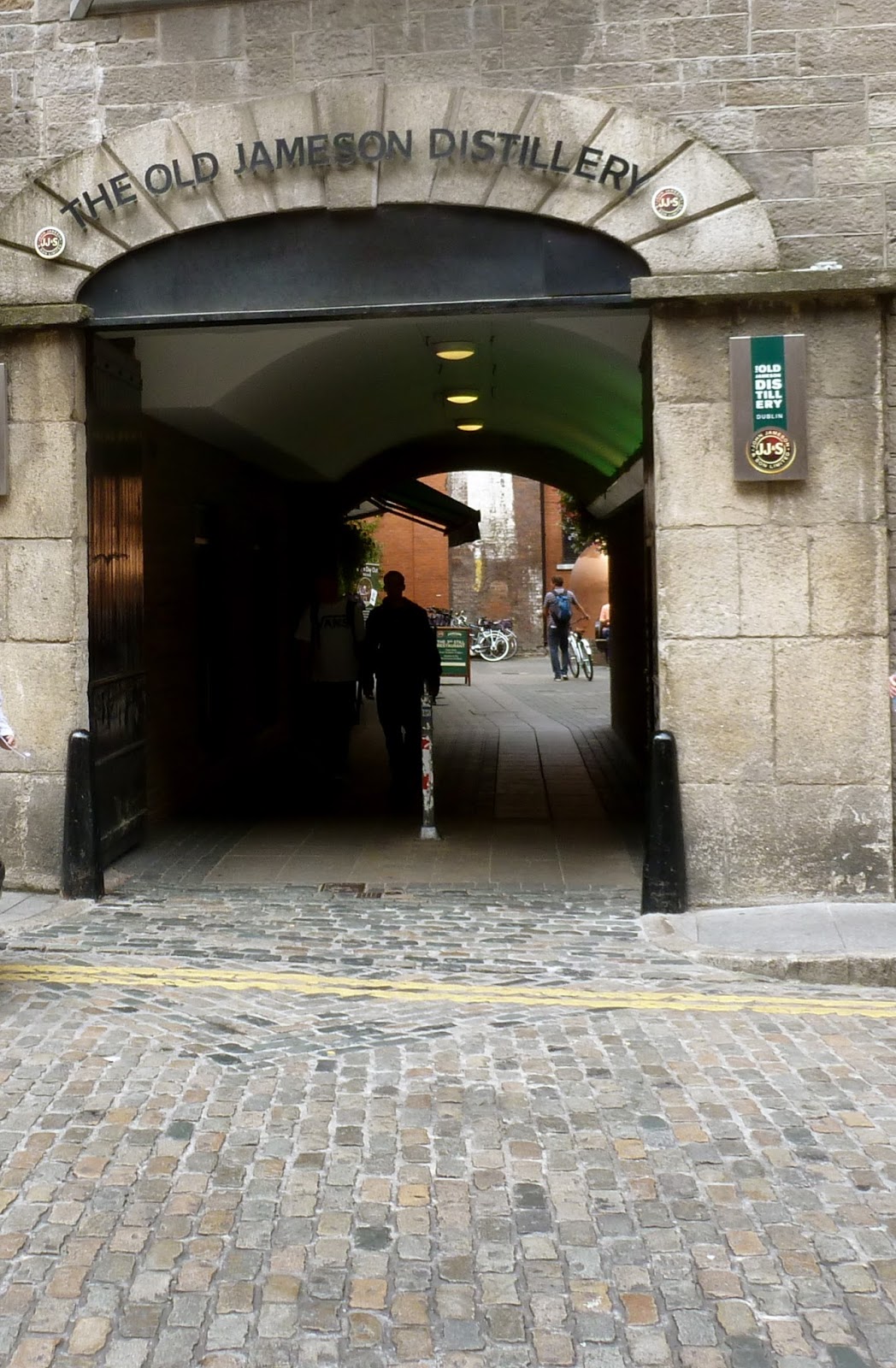
Entry to the old Jameson Distillery 

View of Dublin from the top floor of Guinness Brewery


Besides gazing longingly at Molly’s assets, what else is there to do?

How much time do you have?  I’ve already written about Guinness Stout and Jameson Whiskey.  Between tours and drinking, those two alone will use up the best part of a day.


Yep, you can see castles and churches.  Figure those out for yourself.  But, the first thing I’d do is grab a hop-on-hop-off bus and take a whirlwind tour of the city, which will take you right past Molly Malone.  Don’t worry; the bus supplies earphones and commentary. Dublin ain’t New York.  Won’t take any time at all to spot a bus and buy your ticket right outside the train station.  A complete circle of the ville takes about an hour.  Gives you a great overview of Ireland’s largest city, with a population of over half a million souls.  Hop-on-hop off is not just an expression.  When you find something interesting and decide to hop off, another bus will come along ten minutes later.  A ticket lasts all day.


Another thing to consider that combines two of my favorite interests:  a literary pub tour.  The hours for the tour change with the seasons, so you’re on your own for scheduling.  However, if you’re not familiar with Irish writers, I’ll carelessly drop a few names:  James Joyce, Oscar Wilde, Brendan Behan, George Bernard Shaw, to mention only a few.  This is not to say they lived their entire lives in Dublin, but there is a connection to the city. But as James Joyce famously remarked, “Ireland sober is Ireland stiff.”  A pub tour is a good compromise between literature and sobriety.  A good many writers felt the same.  My favorite quote about Dublin comes from J.P.  Donleavy, author of The Ginger Man, and other novels:  “When I die I want to decompose in a barrel of porter and have it served in all the pubs in Dublin.”

Always time for a pub and a Stout!

And of course a pub lunch


I’ve given Joyce’s Ullyses a good shot, both sober and otherwise.  No dice.  Couldn’t gulp down the prose under any conditions.  The pundits call it the greatest novel.  I found it a disconnected ramble.  But, if you want a taste of Joyce, Dubliners is a wonderful collection of sketches of Dublin life.  Many of the sentences in that short book are cogent.

A bit about the Irish Republic’s government:  parliamentary system, much like other European parliaments. The original parliament building was closed with the Act of Union (with England) in 1800.  Since then, the old parliament building has been The Bank of Ireland.  It sits right next to Trinity College.  Ireland is a part of the European Union and the currency is the Euro.

Best of all, Dublin is a city for strolling, soaking in the atmosphere and chatting with people you didn’t know five minutes ago.  The first thing you notice is the charm of Dublin’s historic shabbiness.  That’s just another way of saying “a comfortable pair of well-worn shoes.”  Easy to fit in here.  Do a bit of shopping.  Stop in a pub.  Make a hundred friends.  Sketch out the plot for your first novel.  You can always marvel at the crusty vellum (calfskin) text of The Book of Kells (800 A.D.) at Trinity College later, or read about the long hard road to Irish independence and visit those sites where Irish statehood was written in blood and tears.  See Dublin Castle and The Garden of Remembrance.  Don't neglect those. But, first, let’s rub elbows down tha pub, have a pint of your favorite, and breathe some air in Dublin’s fair city.


Butler's also offers tours of the factory

From the Book of Kells


Jameson Whiskey: It's Irish, really!

Entrance to the old Bow Street Distillery

Courtyard of the Bow Street Distillery.  Note the old copper 'pot' still.


Before you’re admitted to the exclusive Irish Whiskey club, you have to answer a few invasive questions.  What is Celtic and what is Gaelic?  How do you say ‘Cheers’ in Irish?  How do you pronounce Celtic?  What time do you go to work and is your wife alone?

Careful! The eternal salvation of your slushy, spirit-drinking soul depends on your answers.

Because I am of a generous Spirit, so to speak, I’ll sneak you my copy of the Cliff Notes:

In Ireland, Gaelic is the language, Celtic is the race.  But you can also say Celtic languages, which encompasses Scotch, Welch, and several others.  So how do you say ‘cheers’ in Gaelic? Sláinte!  That’s pronounced ‘slant-cha’ and it means health.

Only kidding about your wife.  Monogamy was meant to save Men from hell-on-earth.

How do you pronounce Celtic?  Damn this is getting tough.  American basketball fans always say ‘Sell-tic.’  The Irish and everyone else in the known world says ‘Kelt-tic.’  So, ya gotta decide, Punk.  Do ya wanna be a man of the world, drive fast cars, drink good whiskey, and be very close friends with gorgeous women, or do you wanna grow up to be a basketball fan? …hurry up, Punk, the clock’s ticking…

Next, let’s get some nasty little secrets out in the open.  Jameson is no longer owned by an Irish Company.  A foppish, Frenchy firm, Pernod-Ricard owns the paperwork.  Besides Jameson (Irish Distillers), you’d recognize a bunch of other names P-R scarped up in their unscrupulous efforts to dominate the spiritual world and look down their Gallic noses from a great distance.  Should you want to further arm yourself against this conspiracy, check this link and scroll down: http://en.wikipedia.org/wiki/Pernod_Ricard

As a public service, I ask that you help us kick those effete wine-swillers out of Ireland!  Send generous donations to stroudallover.blogspot.com.  I faithfully swear that all money will go directly to the Irish Whiskey Rebellion and that I will fight to the last drop.

Some would say that because of international corporate wheeling and dealing, Jameson is no longer truly an Irish whiskey.  I say to that:  Kiss my Blarney Stone.  The French may own it, but the Irish still make it.

Jameson has some other not so closely guarded secrets.  John Jameson started making Jameson whiskey in 1780, at the Bow Street Distillery in Dublin.  No longer.  In 1966 a bunch of Irish distillers joined forces and built the Midleton Distillery in Cork, where all of Jameson is now distilled.  The old Bow Street distillery has been turned into a visitor’s center, where they give tours and tell the Jameson story while you drink yourself silly.  They also offer ‘whiskey-tasting,’ which is a game of finding your preference before your taste buds and the rest of your body goes numb.

One of the biggest non-secrets is that John Jameson was not Irish.  He was a Scotsman!

Into the old Bow Street Distillery.  Get there early for the tours.  They fill up fast, unlike the Guinness tours which are continuous.  Just walking inside the old place is a treat. While you wait, there's a bar and a gift shop.  Yep, they do sell their whiskey right here!


Another use for whiskey bottles.


Which brings us to the question of how Irish Whiskey and Scotch Whiskey differ?  All whiskey starts out pretty much the same.  Barley.  Water.  Yeast.  Jameson also uses corn (maize). The barley is malted, meaning drenched with water and allowed to sprout.  Then it’s dried.  And here’s the main difference:  Scotch malted barley is dried using a peat fire, which imparts a smoky flavor, with some variations in smokiness.  Irish malted barley is dried in kilns, using pure hot air.  No smoky flavor. It’s then distilled to increase the alcoholic content.  With Jameson, it’s distilled three times.

The maturing process is essentially the same.  Jameson uses oak and oloroso sherry, and port casks or barrels.  Before it’s bottled, the whiskeys are ‘vatted’ together to allow the flavors to blend. Vatting still takes place in Dublin.

What’s the difference between a cask and a barrel?  None.  But there are differences between barrels.  A Brit beer barrel holds 36 Imperial gallons, or a little over 43 US gallons.  Cognac barrel = 79 usgal.  Bordeaux wine barrel = 59 usgal

Although Jameson does make a single malt variety, most of their whiskey is a combination of malted mash combined with un-malted mash and distilled in a pot still.  Lots of purists out there are going to call me on this and say there are a lot more differences.  Yeah, yeah, I know.  And, in whiskey making, every little change makes a difference in the final flavor, etc.  I say, dry up and pour!

At the distillery, you can do a tasting or op for one of those phuu-phuu drinks with fruity things and mounds of sugar that ruins good whiskey.  I'm keeping it a secret which way I lean.

The real stuff!


Citrus and stuff

Cherry and stuff


Fast Facts:  Jameson is the 3rd largest single-distillery whiskey in the world.  Each year about 4 million cases (48 million bottles) are sold world-wide, making it the best selling Irish Whiskey!


Great, but what does it taste like?  Just purchased a bottle of Jameson 12 year old.  In a word, fabulous.  Smooth.  Soft hints of the sweetness of sherry, and the woodiness of oak.  Notes of cinnamon. The finish is smooth as glass, with full flavor and no burn.  Taste, like perversion, is such a personal matter that I hate to take a stand.  Scotch?  Irish?  I would never denigrate the Scots and their superb whiskies.  The breadth of flavors is extraordinary.  But, for now, I’m sticking with Jameson 12 Year Old.  Sláinte!


Smooth sippin'!!

A Little bit of Ireland, A Lot of Guinness

If you don't acquire this taste, you'll never forgive yourself.


Dublin.  Only one thing you need to remember:  Guinness.  Oh sure, there’s a castle, a cathedral, a history that dates back to the murdering, marauding, plundering, pillaging Vikings.  There are the uprisings against British rule that led to independence.  Sorry, no time for all that, once I get beer on my mind.  Speaking of historic dates, only one of those you need to remember:  1759. 

Barley

Guinness and 1759.  They dovetail.  It was 1759 when Arthur Guinness purchased a run-down brewery at St James Gate and took out a 9,000 year lease, at 45 £ per year.  That’s what I call confidence.

All began over some burned barley.  Ever seen barley?  Ever tasted barley?  Know what the hell barley is???  Let’s set the record straight.  First off, you undereducated inebriate, barley is a grain and to see it growing, you wouldn’t know whether you were looking at barley or wheat.  Secondly, you swilling swine, you only need four ingredients to brew beer and barley is one of them.  The other three are hops, yeast, and water.  Guinness adds a bit of a twist, using both malted and un-malted barley.  What does malted mean?  It means the barley was drenched with water and allowed to sprout before being dried. 

A factoid:  Guinness uses 100,000 tons of Irish barley every year.

How about the water?  Legend has it that Guinness is brewed with water from the River Liffey, which flows right through the center of Dublin.  Legend has it wrong.  The eight million liters of water that flow through the Guinness Brewery each day comes from the Wicklow Mountains, right above the city. Wicklow water has a low mineral content, which is another thing in its favor.

Factoid:  Water, in brewing terms, is called liquor.


Then there are the other two ingredients:  Yeast and hops.  Unlike barley, hops grows in fifteen foot strands of greenery.  Harvested by cutting off great ropes of the stuff, it’s then fed through a machine that separates the little cabbage-like balls that will add spice and bitterness to the brew.

Yeast adds the magic.  The little yeast beasts multiply and feed off the sugar of the barley and hops to produce alcohol.  The Egyptians, of pyramid fame, first used yeast and no beer (or whiskey, for that matter) would be complete without it.  Different types of beers generally use specific strains of yeast, although frequent readers of my blog will know that the Belgians are content to use whatever yeast happens to drift in.

See how quickly you can graduate to being a well-informed drunk?  Education is everything.  Well, you also need confidence and foresight.  Those two got me stumped.  I can only do so much.

But, forget about me for the moment and get back to Guinness.  Arthur heard about a man who had over-roasted his barley.  But, instead of throwing it away, the man went ahead with the brewing.  That led to a solidly dark beer, sold inexpensively to porters working at the Dublin docks, hence the name for dark beer:  Porter.   Arthur did the brew one better and called his creation Stout Porter.  At St James Gate, they brew about three million pints ever day.  The porter part was later dropped and now in over a hundred and fifty countries people happily raise a glass of Guinness Stout.  It’s not for nothing that the saying goes:  There’s a little bit of the Irish in all of us.

The self-guided tour is a wonder in itself.  The old part of the brewery, with equipment dating back to the turn of the 19th Century, is rearranged, with huge photos and videos, running waterfalls, numerous descriptions of the brewing process and something I found particularly fascinating, a video of barrel makers at work.  Sadly, Guinness is no longer stored and taken to market in wooden barrels, but for centuries, men chopped and shaped oak, all by hand, and almost without measuring.  At the height of wooden barrel usage, 300 artisans turned out a thousand barrels a day.  A few decades ago, Guinness graduated to steel kegs.  Easier to produce and store and much easier to ship.


So, you’ve had your tour and are ready for the tasting.  Best place to do that is the 7thfloor, offering not only a delicious pint, but also a panoramic view of the brewery’s 50 acres, and the entire city of Dublin.

50 acres of brewery....And Beyond!
 
Ok, I admit that Guinness, as black as ink and spiced with the bitterness of hops, is an acquired taste.  Matter of fact, it took me almost 30 seconds to acquire it, about half the time it takes to pull a pint.  The dark brew washes into the bottom of the glass and bubbles rush to the top, so tiny it’s almost like watching a dark kaleidoscope.  The barkeep adds a bit more.  You wait.  Then there’s the top-off and you’re ready to become a devotee of one of the tastiest and most storied brews on earth.  The Guinness team likes to say, besides everything else there’s a fifth ingredient in their brew, a little bit of


Arthur, who dreamed big in 1759 and
bequeathed his dream to all of us.

So here’s to you Arthur, and here’s to your creation.  Cheers! Or, as the Scots say, Slainte Mhor!


7th Floor Tasting Room

Pulling a Pint

...patience now...


Related Posts Plugin for WordPress, Blogger...