Showing posts with label Medieval. Show all posts

Waterford Ain't Just Crystal


Reginald's Tower. Named for, (Irish-Viking) ruler of the city Ragnall MacGillemaire
Inside the tower. 


Waterford, Ireland.  What's the first thing you think of?  If you even mention 'World famous crystal,' you're too far into your feminine side, unless you're a woman.  Then you're right in the doe-eyed, credit card zone. 

When a man’s man, the kind of guy who can swill a beer and belch out the flame of a candle twenty feet away, thinks of Ireland, two things cross his Cro-Magnon  mind:  Guinness and whiskey.  Ok, maybe a third thing, but since your wife is looking over your shoulder, we won’t mention the gorgeous redheads, the statuesque figures, the looks you know in your heart are only meant for you.

No, instead, let’s concentrate on marauding, plundering, gleaming swords, battles, and other precursors to football and golf.

Ok, take a thought mulligan.  What’s the first thing you think of in Waterford?  Vikings!  Yes!  Those masters of the longboat, explorers extraordinaire, feared by conquered men, adored by conquered women…. those tall, blond guys, festooned in animal skins, horned helmets, and waving heavy swords.  They founded Waterford.  Pretty big settlement in the 900’s.  Still is.  They built their city in a large triangle at the water’s edge, surrounded by a timbered wall.  Today’s the area is still known as The Viking Triangleand encompasses much of the old city.

You won’t visit Waterford without hearing of The Viking Triangle, but let’s add some names to get your visit in gear:  Reginald’s Tower, The Bishop’s Palace, The Waterford Museum of Treasures, and of course the Waterford Crystal Factory.   The good news is all four are only a block or two apart. Tours are offered at all four places. Better news:  pubs are also an easy walk.  

Keep in mind, those are only the big four.  Lots of other olden things to see if you're in town for a few days.  From the shoreline, to the harbor, to the old churches and monasteries, Ireland's second largest city will keep you entertained.

Statue of Luke Wadding, outside Greyfriars monastery.  He's the chap who got the pope to make St Patrick's Day a feast day.  Hey, we can all drink to that!

Cathedral of the Most Holy Trinity.  Seems kinda plain for a Catholic church.  When they built it, the Catholics had to keep it simple of avoid offending the Protestants.


The only real question is, how long can you can stare at relics before a desperate need for a pint of Guinness or a drop of Ireland’s finest whiskey grabs you in a vice-like grip and forces you into a pub. I give you two hours, max.

But onward to the treasures of Waterford.

Reginald’s Tower is at the point of The Viking Triangle closest to the water’s edge.  The Vikings built it of wood, but over the centuries, pockmarked by wars and rebuilt by various owners, original wood morphed to stone.  Along the way, the tower’s been a jail, a mint, a castle, and now a museum.  The tour guide waxes well about the history, as well as the civil and hygienic conditions on the long road from then to today.  It’s said that the tower is the oldest standing building in Ireland.

Down the street is The Bishop’s Palace.  If the tower sings of the Vikings, The Bishop’s Palace gets you into the middle 1700s.  Reinactors guide you room to room through the foibles of yesteryear.  Lots of original furnishings and you can see one of the earliest examples of Waterford Crystal.

Inside the Bishop's Palace

 
Oldest Waterford crystal in the world.

To the side of The Bishop’s Palace stands The Waterford Museum of Treasures, which will lead you through 1000 years of fascinating history.  Wars, the Church, Kings, and knaves all intertwine.  If you want to know about medieval Waterford, this is the place.  Far from dusty and boring, this museum first opened in 1999 and is first class.  Bright.  Airy.  Well presented. Great coffee shop. You will especially want to view the gold vestments and hear of their improbable journey.

Here are a few of the treasures:
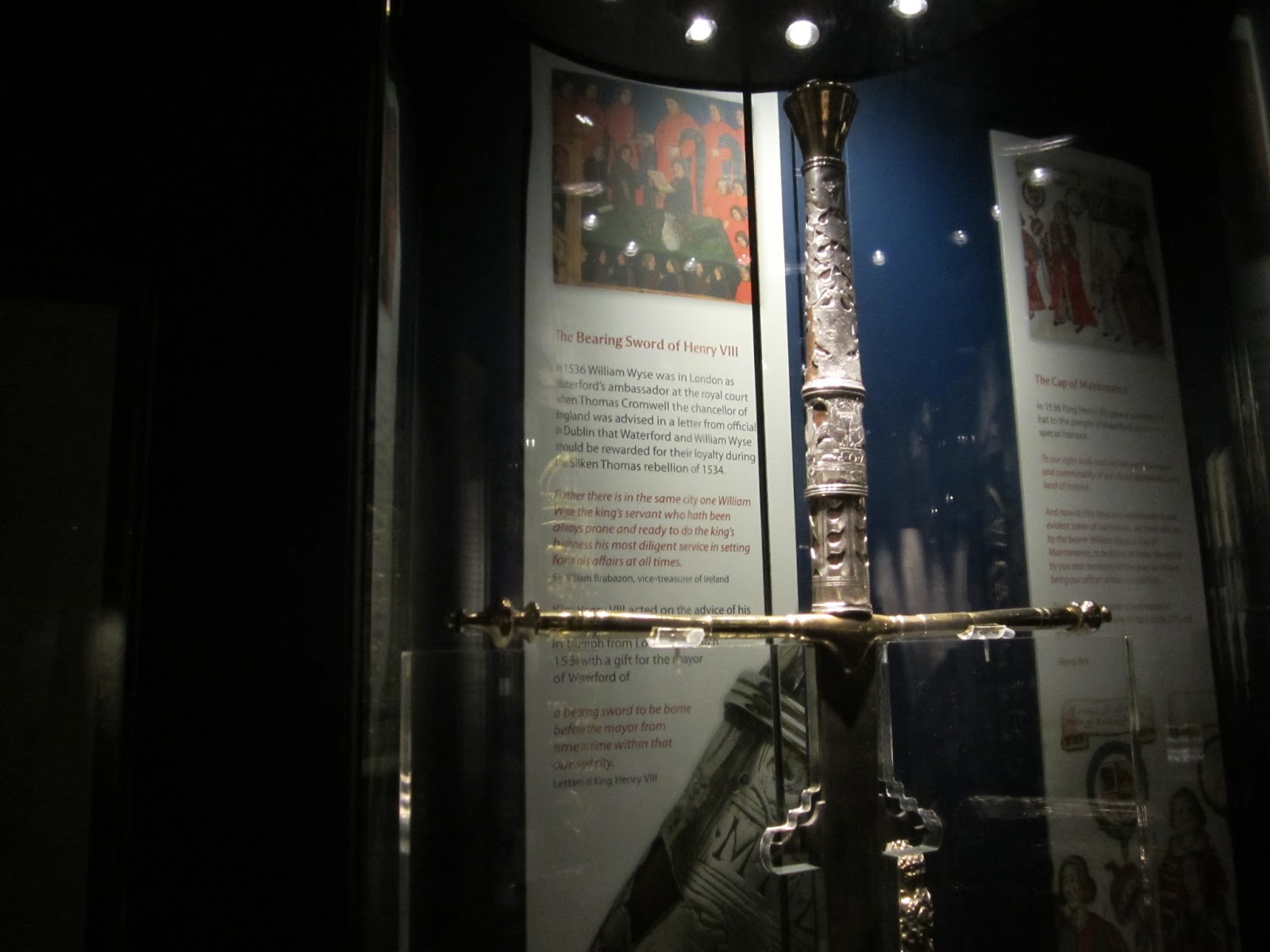
Henry VIII's sword

His hat.

Just one of the seven gold vestments, buried and recovered.


Across the street from The Bishop’s Palace is the Waterford Crystal Factory and showroom.  There are tours, but be warned, they fill up fast. Even if you don’t do the tour, walk through the stunning showroom.


Since its beginning as Primrose Glass Company in 1783, Waterford Crystal has had its ups and downs, but somehow always survived because of quality and demand.  I suggest this link if you want to read more:


Now for a drink.  Walk down the street.  Look for a crowd of boisterous barbarians.  Go inside.  Ah, that’s better.  Education is a thirsty business.

Flowers adorn this city!

That boisterous crowd you were looking for.

A bit of shopping.

End it with a pub lunch:  Shepard's pie!

Storming the Castle: just another summer's day

Be sure to scroll down for more photos and enlightenment


Burg Lichtenberg is a cozy little castle, high on a hill overlooking the city of Kusel.  Don’t worry if you haven’t seen it yet.  It’ been standing guard over the valley since 1200 and is not likely to disappear soon.

The neat thing about Lichtenberg is that it’s useful, which is more than you can say for most things built in 1200.  From spring through fall there are festivals.  Also a restaurant.  Also a youth hostel.  No end to the possibilities.

Last weekend was an herb fest, complete with garden ornaments, plants for sale, the obligatory beer and wurst, plus guided herb tours around the castle walls and an explanatory visit to the castle’s own herb garden.

I forget to mention the three-piece band, with middle aged musicians playing and singing John Denver favorites in German and English. Henry John Deutschendorf, Jr. ( his real name) translates well, or at least the emotions do.  Everyone can understand the yearning to go home to West by-god Virginia, or Rocky Mountain High…speaking of herbs.

I learned a few things during the semi-walk around the castle walls.  Camille tea comes from little, white, daisy-like flowers, which I would have known had I paid more attention to the picture on the packaging.  Supposedly, you can also brew a strong batch and use it to heal skin ailments.  I recommend letting it cool first, but hey, you’re your own boss.

The lady who led us around was the college professor who knew too much for our own good.  Apparently, leaving any tidbit out would have been a sin against all of academia.  My mind started to drift when two herbs took the first thirty minutes.  I started to chew weeds and paw the ground. We’d traveled ten meters and it was a loooooog way around the castle walls.  I regretted my lackey hadn’t brought a tent and provisions.  Plus, the soliloquy was in German, so I could only catch every other word:  good, tea, good again, etc.  I yearned for the Cliff Notes.  Time to break ranks and sprint for beer.  Got to the beer stand and put the golden-coldie to my lips just in time.

Next weekend is a much bigger, Medieval Festival, with even more food booths, knights in armor, complete with squires and horses, sword fights, and winsome ladies in flowing gowns.  Beer.  Wurst.  Sunshine.

If you miss that one (and why on earth should you?), I’m sure there are others coming up.  But, if they offer a tour around the castle walls, drag a keg with you.


Rebollita - My Version of an Italian Fave


Ok, let’s get this straight…I did not invent this soup.  I shamelessly downloaded a link that was mentioned on a wonderful wine blog written by a friend of mine, Laura Uncorked, and then made some not so discrete changes.  (There’s a link to Ms Uncorkced’s blog in the margin to the right.)

But, to be truthful, nobody invented ribollita, or nobody whose name is ever mentioned in the annals of history.  Legend has it that serfs reboiled (rebollita) the bread trenchers left over from the nobles’ feasts, adding veggies and broth.  But, not much evolved clearly from the mist of medieval history.  Weren’t those the folks who thought the sun revolved around the earth and had the Inquisition make Galileo Galilei swear to it?  I suspect waterboarding was not the issue it is today and fact and fiction were held in equally high esteem.

One thing for sure, this soup will fill your guests' stomach cavities, every one.  Want to add an interesting white wine?  Check Ms Uncorked’s blog, or pop the top on one of my favorites, a gewürztraminer, and let your tantalized tongue tingle.

Disclaimer!!!  What does it mean when I say this is MY version?  It means I DID NOT USE TRENCHERS FROM THE NOBLES’ MEALS.  Nor did I make Galileo swear to anything. 

Since every Italian mother, son, daughter-in-law, and street vendor has his/her/its own version of rebollita, I high-fived culinary tradition and unabashedly joined the rebollita conga line.

Ribollita – I did it my way


Serves 8 or more, so use a big pot.

These are the ingredients, but you really can’t go wrong.  Don’t have something?  Substitute something else.  That’s what the peasants did when the nobles weren’t looking.

2  15 oz cans cannellini or great northern beans, undrained
1/4 cup olive oil
1/4 pound pancetta or smoked lean bacon (if you must)
1 lb chopped pork – I use the lean, stir-fry strips, but chop them
2 onions, well chopped
1 Cup carrots, well chopped
1 Cup chopped celery
6 cloves garlic, finely diced
1 teaspoon black pepper, fresh ground or coarse ground
1/4 teaspoon red pepper flakes
1 14 oz can plumb tomatoes, drained well and tomatoes chopped
1 package frozen leaf spinach, thawed
handful fresh basil leaves, chopped
4 Cups chicken broth
4 Cups sourdough bread, cubed (one small, round loaf should do the trick)
Parmesan cheese

Puttin’ it together…


Drizzle the oil in a large pot and add the onion, garlic and pancetta.  Cook until the onion is wilted.  Add the chopped pork, and all the vegetables except the beans and tomatoes.  Stir well and add all the spices except the basil.  Stir.  Add the chicken broth.

Do not drain either can of beans, but put the contents of one can in a blender, or food processor and puree it.

Add the whole and pureed beans to the soup.  Bring to a boil, reduce heat to a simmer and cook for 30 minutes to fully cook the vegetables and allow the flavors to blend.

Add the chopped tomatoes and cubes of sourdough bread.  Stir.  Cook another ten minutes.

Sprinkle basil and Parmesan cheese over individual bowls.

Make this recipe a day or two ahead if you wish.

You’re going to feel so Italian you’ll find yourself waving your hands, talking loudly, and reaching for more wine.  Keep a bottle handy.


Racin' to Rothenburg ob der Tauber


St George fountain (1608), 8 meters (26 ft) deep, with a capacity of 100, 000 liters.

In good weather, cafes are everywhere.

Stroll the old market square.  The buildings date from the Renaissance. 

...or sit in the market square and enjoy a cup.

(more photos follow this sparkling epistle to travelers)

Rothenburg,  pronounced Row-ten-burk, is one of the primo tourist attractions in all of Europe.  Amazing that it is not yet a UNESCO World Heritage Site. 

When people first began to stack rocks and roast deer in Rothenburg, Native Americans were running rampant through Manhattan, Conquistadores were searching in vain for the cities of gold, and the U.S. wouldn’t be a nation for another five hundred years.  Lots of cities in Europe make the same boast; however, most don’t have a well-preserved medieval wall.  I’m not talking about a collection of loosely organized stacks of rocks, but a well laid out town, with a high, unbroken wall, complete with towers, narrow gates, half-timbered buildings galore, and cobblestone streets.  In the past few hundred years, they’ve added some swank hotels, restaurants and shops, and cappuccino emporiums bubbling out onto the market square.

While I’m a fan of cobblestone streets in theory, the reality is, they’re tough on your feet and ankles, unless you were born in the 12th Century and feature cobblestones as a significant improvement over muddy lanes, slick with horse droppings, and smelling of garbage and human feces.  Ah, the good old days.  Take a deep breath.

Why here?  Why did a city arise and prosper just above a small, insignificant river?  As the realtor said, location, location, etc.  Seems the east-west trade route from Turkey to Paris intersected the north-south trade route just a few hundred meters outside of Rothenburg.  The city of 5,000 folk prospered.  Until the middle of the Thirty Years War, when a Catholic army, through a stroke of bad luck, came to this Protestant town.

General Tilly, with his army of some 40,000 was passing by in 1631 when a drenching rain turned the roads to brown muck, stalling caissons and cannon, and bringing the army to a dead stop. Unlucky for Rothenburg.  What to do with an army of that size that needed feeding and housing?  Send word to the town to surrender.

Tilly didn’t get the answer he expected.  Siege and victory.  Rape, pillage, and plunder followed, and afterwards the black plague delivered a second crippling blow, bringing ruin and two hundred and fifty years of poverty.  But, everything has a bright side.  The city grew no more.  The walls remained, preserved until the present day.

Later, tourism peeped in, with a joyous smile, and saved the fortunes of the town.

There are a number of interesting stories about Rothenburg, one of which occurred during the last days of the Second World War.  But, you really need to visit this fine old city, take a room for a night or two, enjoy some Franconian beer and wine, and by all means go on a tour at dusk with Hans Georg Baumgartner, The Night Watchman. He’s been plying his trade for some twenty years.  As everyone knows, the watchman sees all and in this case tells all.  History delivered with wry sense of humor right out of the Borsht Belt. Secrets of Rothenburg revealed.

Walk the walls, visit the Kriminalmuseum and see how justice has changed, not always for the better.  Check out the ‘twin violins’ that latched people together until they could agree to get along and stop arguing.  Let’s take a collection and send a few hundred pair to Congress. 

Visit St Jacob’s Church, as magnificent as any cathedral.  Take a chance and go to hell…..an inn called Hell, that is.

What kind of money are we talking about?  Rooms run from the super reasonable, to the super expensive.  Bed and Breakfasts abound.  Eat well for a hundred dollars, or for five dollars.  This city doesn’t gouge its guests, it welcomes them, and has since the 12th Century.

View from the Palace Gardens.  The Palace itself was destroyed in an earthquake.

A small view of the magnificent wall.

Also destroyed in the 1356 earthquake,
the prison was rebuilt in 1400.

Beauty, beauty everywhere.

Walk the wall for views like this.

The Night Watchman, a tour not to be missed.

Not Evil, Medieval – All’s Fair at the Fair

Lichtenberg


Leather mask, handmade, hand painted

Entry to the castle


"Spinning wheels got to go 'round..."


I know the question that’s burning in your soul.  You there. Yeah, you, the one waving your hand like a battle flag.  What does medieval mean???

Medieval is usually spoken of (in polite society, e.g. those that don’t still eat with their hands and throw bones at the yapping dogs) as the time between antiquity and the Renaissance. So put the years between the fall of Rome and when the lights came back on, from about 476 A.D and the fall of Constantinople in 1453.  There was no light switch.  More like a lingering sunrise that took a couple of hundred years.

But, we usually don’t think of the Middle Ages that way.  We picture knights, fair ladies, jousting, feasts, colorful tents. We overlook lords and serfs, a complete lack of physical hygiene, rotting teeth, women’s bodies worn out from having a score of babies, and death by the age of 45.  Hollywood does wonderful things to reality.

Camelot!  Hey, that’s the ticket.  Utopia, mostly, except for evil knights, etc.  Ok, let’s go with Utopia, the quest for the Holy Grail and stuff like that.  We’re talking gooooood times.

I went to a place like that on Saturday at the 6thannual Medieval Market at the Lichtenberg Market near Kusel.  (Burgstraße 12, 66871 Thallichtenberg).  Lots of lords, ladies, colorful tents, great food and a host of ancient handicrafts.  Friendly crowds.  In short, the Middle Ages, as they should have been.  Jugglers.  Sword fighting.  Blacksmithing.  Leather crafts.  Shoes with turned up toes.  Damsels in long dresses, with pretty smiles and braided hair.

This market is gone until next year, but look around and ask at any tourist office and you’ll be steered to another Camelot.  Well worth the drive, for the pageantry, a view from a castle, seeing friendly force of arms, and best of all a belly full of handmade sausages and old-fashioned mugs of ale.


Pizza - a medieval favorite...


Farewell to the Fair

Related Posts Plugin for WordPress, Blogger...