Showing posts with label seafood. Show all posts

Paella Party - Olé!


It’s always nice to have friends, and not just when you need money or you’re your wife has thrown you out.  They’re especially wonderful when they can cook, and especially if they’ll teach you how.  Drinking you’ll have to learn on your own, although friends can be very helpful there, too.

I don’t disparage anyone’s cooking.  Great Cuisines cover the world.  None of them bad, unless you catch the Koreans on a night when they’ve run out of meat and you notice their dog isn’t barking.  Mexican menudo?…not a fan.

The Europeans in general?  Superb.  But, when it comes to the trifecta, drinking, eating, and partying,  the Spanish take a backseat to nobody.  These folks can start in the late afternoon and finish up with supper at midnight.  Everyone know the prime restaurant seating in Madrid is 10:30 p.m.?  Show up a couple of hours early and you’ll have the place to yourself.

Through my wife, I met a couple, he American, and she Spanish. Pili gives cooking lessons, which may also be classed as party lessons, or drinking lessons.  You gather hungry friends.  You make sangria.  You talk for hours and eat well, with discussions on anything that comes to mind after you've been hitting the sangria ... hard!


Lesson number one, Paella.  But with a Spanish woman, cooking is never just cooking.  It’s about having a few noshes to whet the appetite, washed down with wine, sangria, beer, whisky, or anything else that’s wet.  Then there’s an hour or more of conversation, and discussions on the merits of various foods, condiments, the prime importance of bread, and sentimental trips into the childhoods of everyone present.  The lips must be lubricated, as well as the stomach. 

Only Americans are willing to eat without conversation and a migratory pilgrimage to the kitchen. For the Spanish household, if you want to eat, these things are obligatory. Followed by chopping, dicing, and more intense drinking, interspersed with bubbling conversation and impromptu belly laughs.  Oh, yeah, also a few million instructions on creating Paella.  Pili is an exacting cook, which is a major reason why her paella is the stuff of hungry dreams.

If you’re not familiar with paella, here’re some hints.  Big, flat-bottomed pan. Rice. Seafood.  Chicken. Time. Patience.  If you don’t have the slow moving P word in abundance, make another plan.  Above all, paella takes time and preparation.

Let’s cut to the historic chase.  The dish dates only from the mid 19th Century. Paella comes from several words in several languages, all of them meaning pan.  The typical paella pan is round and flat-bottomed, with two-inch high sides that lean outward, and support opposing handles.  A lot of non-Spaniards think of paella as Spain’s national dish, but a Spaniard with tell you no, no, no (with a shake of the head and a wagging of the index finger)…it is a regional dish, from the east coast, specifically the region around the city of Valencia.  Lots of different types of paellas.  Truth is, you can put in any meat you want. 
The Spaniards do. 

You make paella in two parts, the pan cooking part and the broth part. Then you combine them with a finishing flourish and a swish of the spoon.

The Recipe (for 6-8 people)

Part I, initial cooking in the paella pan

Olive Oil (I use only Spanish olive oil!)
3 garlic cloves, thinly sliced.
1 small onion, diced
1 small green bell pepper diced
1 small red bell pepper, half of it diced and half of it cut in medium strips
2 large chicken breasts (or 4 thighs) skinned, boned, and cut in bite sized pieces
2 calamari steaks, cut in strips (easy to do with scissors)
2 medium tomatoes, peeled and diced
2 cups small grain rice (risotto rice works well)
1 cup small scallops
18-24 shrimp (cleaned)
12 mussels ( An hour before cooking, put them in cold, salty water.  This will wash out any grit.  )
A handful of peas (not canned, but frozen is ok)
1 lemon

Part II, The Broth

2 cloves garlic, mashed in a mortar, with salt and chopped parsley
4 cups fish or chicken broth
½ teaspoon smoked paprika
½ teaspoon colorante (either adobo or turmeric)
2 teaspoons chopped parsley (see garlic above)
pinch of saffron
salt to taste  (along the way, you will want to taste from time to time to make sure the paella or the broth is not too salty)

Putting it all together: (you’re going to be dancing back and forth from paella pan to broth.  Read carefully.  Stick with it!)

1.     Coat the bottom of the paella pan with olive oil. Add the 3 sliced garlic cloves and the calamari.  This is to flavor the oil.


2.     Lower the heat.  This is where patience comes in.  Add onions, peppers and peas, along with a bit of salt to help the vegetables sweat. Add the tomatoes. And stir them in.


3.     After a few minutes, take the garlic and calamari out and set aside.  You’ll use them later.


          As the vegetables slowly cook, make the broth in a separate saucepan.  This allows you to taste the broth and get the flavors and color perfect before you add it to the paella pan.  Pour the fish/chicken broth into the saucepan and add the paprika, colorante, reserved sliced garlic and mashed garlic, and a splash or two of either sherry or brandy.  This will help tenderize the meat when the broth is added to the paella pan. Use a white spoon to stir and you will be able to see that the broth is a rich yellow. If it’s too pale, add more colorante.  Cook the broth separately for about 15 minutes to let the flavors meld.


4.     Take the strips of red bell pepper out of the paella pan. They will be used to decorate the dish before serving.  Add the chicken pieces to the paella pan.
5.     Do not stir too much, only enough to turn the chicken.   Don’t worry about the chicken being uncooked.  The paella/chicken will continue to cook as more ingredients are added.


6.     Add rice to the paella pan and stir.  You want the rice to get a nice coating of oil and vegetable juices before you add the broth.
7.     Add the broth to the paella pan and stir quickly, then do not stir again.


8.     Add the prepped mussels to the paella pan. (Do not eat any mussels that have not opened after they are cooked.)  Cook for 15 to 20 minutes.
9.     With 5 minutes to go, decoratively add the scallops and shrimp on top.  Also add the reserved strips of red bell pepper and reserved strips of calamari.


10.  Taste to make sure the rice is cooked.  When it is cooked to your liking, cut a lemon decoratively and put the pieces on top of the paella.  Cover the paella with foil and let it rest for 10-15 minutes.


Remove the foil and serve the paella in a burst of steamy goodness.  Don’t forget the bread, salad, water, and more wine!


Watch your greedy guests smile!  Oh, well, they did bring the wine, right….I mean, they did, didn’t they??


Next lesson:  Tapas!

Deviled Crab -devilishly simple


My mother used to make deviled crab to rave reviews.  This recipe follows hers as closely as my sagging memory allows.

One evening over supper a guest asked how hard deviled crab was to make.  “Oh, it’s very simple,” my mother said, nonchalantly.  “You just toss everything together and slip it in the oven.”

My father’s eyes got big.  He dropped his fork.  “Easy for you to say!  You didn’t spend two goddamned hours dicing every goddamned thing!”  Of course, my father took his dicing responsibilities as seriously as a talented machinist in a watch factory.  If he had made jigsaw puzzles, the pieces would all have been one inch square and you could have measured them with a micrometer.

As for me, as my greedy family constantly reminds me, I am not that perfect, least of all when I’m mincing hard boiled eggs.  Still, when I feed the hungry hordes, they have no problem bellying up to the trough and fighting for the last scraps. Your hordes are going to love this dish, too.

Besides the delicious mingling of flavors, another thing I like about deviled crab is the eye appeal.  Tiny bits of this and that flecked together, lighted browned on top, and served in ramekins, or scallop shells, as my mother used to do…well, they beg for the time honored delight of  rapidly moving the fork to the mouth.

Unlike what my father exclaimed, this recipe only takes about half an hour, including the slicing and dicing, and another 25 minutes baking in a 350ÂşF (180ÂşCÂş) oven.

To keep it simple, and to give the deviled crab first billing, I often serve it with oven-roasted vegetables, which I toss with only a few tablespoons of olive oil, salt, and pepper. The vegetables also bake at 350Âş, for the same 25 minutes.  Finger-sized cuts of carrots, petite green beans, slices of red bell pepper, a few broccoli flowerets, and slices of onion add color, and a rough-cut bistro texture to the plate.  Often I drizzle a bit of balsamic vinegar over the vegetables before serving.

Deviled Crab

1 lb. crab meat – I used a one-pound can of pasteurized and refrigerated mixture of claw and body meat.  Two recommendations:  Fresh crab is best.  Steer clear of the canned crab that requires no refrigeration – absolutely tasteless!

1 Cup mixture of green and white onion, diced
1 Stalk of celery, diced
½ Red bell pepper, diced (use the other half in the mixed, roasted vegetables)
3 Hardboiled eggs, minced (You can use a fork.  I used a pastry blender, the tool for cutting butter into flour)
½ Cup plain breadcrumbs  (a stale baguette and my food processor do the trick)
1 Tablespoon yellow mustard
½ Cup mayonnaise (careful with this; the idea is to moisten, not saturate)
A pinch of cayenne pepper
Salt to taste
3 Lemon wedges


Pick through the crab meat to take out any bits of shell.  Put the crab meat in a bowl and squeeze the lemon wedges over it.  Mix well. 

Add the other diced and minced ingredients and breadcrumbs to the bowl. Toss.

Add the mayonnaise, mustard, and a dash of cayenne – how big a dash depends on you!  I favor truly just a dash.  Crab is a delicate flavor.

Mix and toss well, using forks.  You want to keep the mixture light, not at all packed down.

Again, using forks to keep the mixture from packing, fill the ramekins.  This recipe will serve 4 or 5 as a main course, or 6-8 as an appetizer.


Prior to going in the oven.


Put the ramekins on a cookie tray and pop them in the pre-heated oven for 25 minutes.  The bits deviled crab sticking up should just be turning brown.  If not, leave them in the oven another five minutes, but take care not to overcook!

Fresh out of the oven


A solid supper and devilishly easy.  Serve with dry to semi-dry white sparkling wine.  I suggest two bottles.  One for the meal and one for sipping while you cook.  It makes the time go so much faster and will make you a jolly host.


Pearlz - Slurp Down Those Oysters in Charleston South Carolina


Pearlz Oyster Bar, Charleston, South Carolina...but wait a sec, let’s take a moment to suck in some historic salty air and remember the past...

Charleston’s cobblestone streets have carried the weight of leather soles and horses’ hooves for hundreds of years. The vast port and shoreline has sheltered merchant ships and seen the Pirate’s Jolly Roger. English soldiers and sailors, Confederates, Union soldiers and sailors, and a host of others left their mark. Charleston started as the heart of an English colony and grew to become a center of culture and agriculture in the newly founded United States.  History.  Culture. Food on a grand scale.  What the hell more do you want?

Most people know Charleston as the starting place for the Civil War, or the War of Northern Aggression, as Charlestonians choose to call it. 

Here’s something from an earlier conflict that you may not know.  Although most of the Revolutionary War battles we learn about in history class took place in New England, in sheer numbers, more Revolutionary War battles were fought in South Carolina than in any other state.   It was a long war, 1775 to 1783 and Charleston was smack in the center.

Enough digression.  What’s really important?  Seafood in general, and oysters in particular!  Lots of places to dine on fresh mollusks.  Every corner, every road has a restaurant serving fresh seafood, and the historic downtown area is crammed with ‘em.  Deciding is a challenge.  Fortunately for you, I have faced that challenge victoriously!  

Pearlz is the correct answer.  There are three locations: downtown, West Ashley, and two hours north in the state capital, Columbia.  I wandered into Pearlz on West Ashley and never bothered to try the other two.


An oyster bar is supposed to be dimly lit, with shadows on the walls, fresher than fresh seafood, a New Orleans smell and feel, and lots of style.  I don’t mean style as in Vogue and GQ.  I’m talking about muted colors, tile floors, and people wearing anything from jeans and worn t-shirts to coats and ties. At Pearlz feel free to discuss your glass of remarkable Chardonnay with the stranger on the stool next to you.  Its one of those American melting pots where everyone is welcome and nobody feels out of place.

Cold beer?  You bet.  Lots of it, including several Pearlz labeled brews on tap.  I usually choose the amber variety.  You want good taste, but not too strong a flavor when you’ve sliding oysters down your throat.  Not feeling the beer urge?  Huge wine selection.  Fab martinis.

Let’s move on to the basics.  So, for the first timers, do you chew raw oysters or just let ‘em slide down your throat?  Chew ‘em, for goodness sakes!  What the hell are you, a barbarian?


Sauce or no sauce?  The real aficionados go the naked route, but I prefer a squeeze of lemon and just a tad bit of red sauce, spiced with horseradish.

Pearlz offers a wide selection of oysters, coming all the way from Canada and the Gulf.    All are fresh, plump and delicious, with just a bare bite of the briny. Is there a difference in flavor?  Yes, there is, but prices vary widely.  I go for the cheapest because they’re wonderful and affordable.  Can’t be because I’m just cheap. Nah...

Even if you’re not in the mood for raw oysters (I offer condolences and hope you feel better) there are dozens of ways to enjoy both oysters and seafood and steak and hamburgers at Pearlz.  The fried shrimp tacos simply amaze! The shrimp are fired in a light batter and served over seasoned lettuce in a flour tortilla. The blackened mahi is divine.  Crusty outside.  Juicy within.


Pearlz also makes it’s own potato chips, so wonderfully crisp and tasty they should grace every table.  No exceptions, especially if you’re ‘lack-of-taste’ intolerant, as I am.


When it comes to restaurants, Charleston rivals New Orleans and is catching up fast.  And, at the end of a trying day of plodding the cobblestones, clopping around on a carriage ride, and gaping at historic Charleston’s churches, plantations, and such, you need a place to cast off the travelers’ blues and unwind.  

You’ve found it! Park your ride.  Slip into dark, air-conditioned comfort. Grab a table, booth, or jump on a bar stool.  You’re primed and ready.  “Barkeep, how about a frosty lager and a dozen on the half shell?” Relax. Dig into fresh seafood. 


Hey, this is Pearlz on West Ashley!  Cheers!


Good Day For Fish Soup - Flatter's


There’s a chill in the air.  Leaves are turning.   After a hard morning of shopping (flowers, plants, wine, cheese), thoughts turn to a bright luncheon that fills the gaps, but doesn’t carry the weight of refined carbs and slabs of beef.

When we’re in Homburg, the choices are vast.  For a smallish city, this one steps up a platform or two and caters to those who drive flashy convertibles and drape themselves in Italian wool and sheer silk.  Well, at least the wives and significant others do.  Can’t picture myself in silk, unless it’s tied in a Windsor and fits under a collar.

You can go Asian, with the flare of crunchy Thai or Vietnamese spring rolls, or polish off an elegant schnitzel in a cozy bier stube.  Italian offers the options of lobster filled, hand-rolled ravioli, or stone oven pizza.  But, one thing you’d best not overlook, especially on a chilly day in Homburg, is the heartwarming solace of fish soup.

Flatter’s fish restaurant is as trendy as they come, but not at all pricy.  A big bowl of delicious, chunky, house-made fish soup will run you under ten bucks.  You can also go smaller and cheaper.  Flatter’s rendition reminds me of bouillabaisse, but not quite as heavy.  Matter of fact I’d call Flatter’s version a redolent blend of fish and vegetable soup. 

There are two dining rooms, as well as fresh air seating, and believe it or else, Germans often sit outside, even when the snow is falling and the wind is whistling.  They will never have to fight me for an al fresco seat when the temp can’t make up it’s mind to simply numb your thoughts, or go for the whole body bone chill.  Call me a wimp, but gloves and a scarf will never be necessary at my table.

Germans love the outdoors more than any people I know.  In the dead of winter’s snows, I’ve seen ancient matriarchs pushing their walkers with sure, steady steps, as the drifts swirl.  I’ve seen them from the comfort of the heated seats in my car, I might add.

When we’re at Flatter’s, we prefer to sit at a table in the sunny entry.  Doesn’t sound warm, but with the open kitchen barely ten feet away, it is.   Great view of passing pedestrians and the bustle of the city.

Inside, right by our table, the chef and sous-chef busy themselves, while clerks cater to clientele purchasing both fresh and prepared seafood.  Yes, Flatter’s is also a tidy little fish market.

Back to fish soup.  Lunch is an event in every European restaurant I’ve ever been to.  None of this rush in and rush out.  The feeling is, if you don’t have time to dine, don’t go.

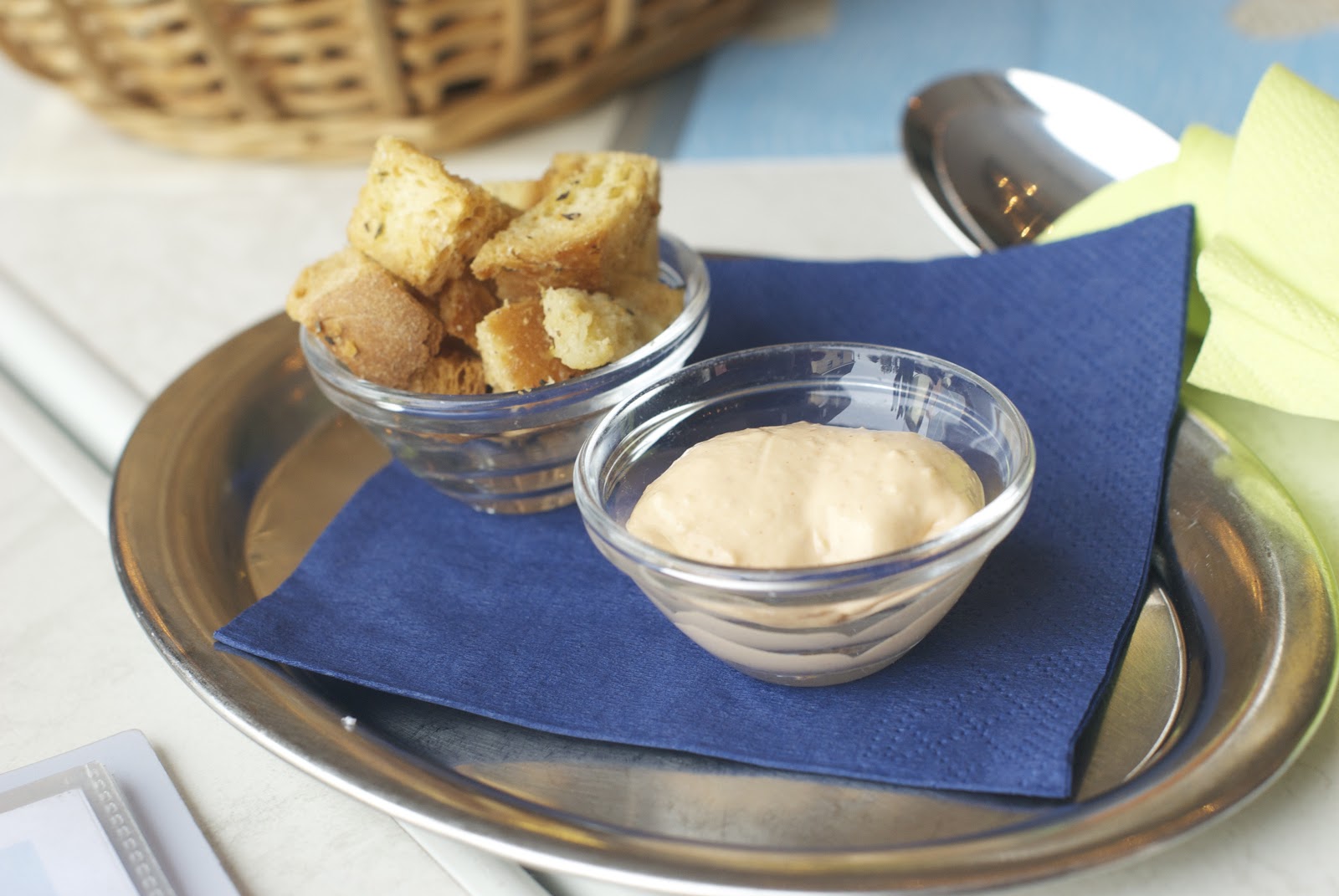
The waitress approaches and takes our order.  We go for a pleasant Pinot Blanc.  Something to tickle the taste buds, but not overpower the delicate flavors of the sea.  She comes back with wine, and afterwards with a basket of freshly cut baguette, and a dish of herbed mayo spread.

I can go either way with the spreads.  Bread over here is spine-tingling delicious.  The aroma wafts past the nostrils before you take a crunchy bite that ends with a smooth soft finish.  It’s the way bread is supposed to be, and today it don’t need no stinking spread.  My wife feels differently and of course, gentleman that I am, I simply snicker, without coming right out with a well justified criticism.  One secret of marital bliss is to avoid eye contact when you snicker.  Plausible denial.

We sit comfortably, sip, chew the bread, and watch pitiful shoppers brave the cold.  Then, our soup arrives and our thoughts channel to the heavenly aroma and exquisite taste.  Fish soup can be overpoweringly fishy, or so bland you wonder what you’re eating.  Flotter’s fish soup is neither.  It carries the breath of the sea, with an abundant taste that lets you know you’re eating fresh catch.  Just spicy enough, and with the surrounding vegetable broth, the flavors accomplish all you’d hoped they would.

The soup comes with crunchy croutons and a slightly spicy cream sauce.  Both add to the enjoyment!

We while away an hour or more, enjoying the wine, the atmosphere, and each other’s company, and chat about the things she wants to chat about.  Another secret to marital bliss.  Come on guys, put your mind in gear.  As long as you’ve got a nice wine in front of you, you can do it!  “Waitress, another over here, please!”


Clam & Salmon Chowder

The other week I was lamenting on Facebook how difficult it is to live on a $50/week food budget, and one of my friends told me about two blogs she regularly uses that are focused on creating cheaper dishes for those on tight budgets.  I could live on $50/week if I wasn't buying baking ingredients all the time, though, but that's besides the point.  I'm not going without baking ingredients.  I am realizing how lucky I was in Rossland that my dad regularly contributed baking ingredients to my pantry since I baked things for him, too.  Ah well.  I do my best, and usually I succeed.

Anyway!  The two blogs I mentioned are Budget Bytes and Poor Girl Eats Well.  Budget Bytes is particularly interesting because the author does a comprehensive breakdown of her ingredient prices to get an accurate price per serving amount.  This inspired me to do some of my own calculating, just for interest's sake.

The other night I made a salmon and clam chowder for dinner.  The story behind the salmon is that I saw a package of ground salmon in the grocery store that looked perfect for a salmon burger.  But when I got it home to make the burger, I saw that the meat had not been ground properly and that is was in long thin shreds.  So froze it for a later use and decided to stick it into some clam chowder.

So here is what I used, the prices, and then the price per serving.  I got 8 servings out of this recipe and put half of it into containers for freezing.

2 cans clams @ $1.67 each = $3.34
half of one container of 10% cream = $0.86
carrots = $0.37
potatoes = $0.76
6 slices bacon (17 slices/package at $4.97/package = $0.29/slice) = $1.74
1 cup of whipping cream left over from another recipe = $1.39
fresh thyme left over from another recipe = $2 (approx.)
salmon = $2.79 (approx. - I didn't keep the receipt for this as I bought it a few weeks before I started keeping track, but this is what I remember it to be approximately)

total cost of chowder = $13.25
8 servings = $1.65/serving

Not bad, eh?  There is room for improvement, though.  But not bad at all.  And the chowder was good!
Related Posts Plugin for WordPress, Blogger...